New preprint: a monolithic interferometer for high harmonics from solids
In Mohanad’s new preprint, we present an inherently stable interferometer for high harmonics generated in thin semiconductor films. We use it to gain new insights into the electron dynamics, namely Bloch oscillations, that drive high-harmonic generation in semiconductors.
When an intense laser pulse drives a semiconductor, electrons are accelerated through the crystal’s band structure within a fraction of an optical cycle. In the process, they perform Bloch oscillations and give rise to the emission of high-order harmonics of the laser frequency. The phase of the emitted harmonics, the so-called dipole phase, carries information about the underlying electron dynamics. In gas-phase high-harmonic generation (HHG), measuring the dipole phase was key to understanding the recollision physics behind attosecond pulse generation. For HHG in solids, however, previous measurements have not yet yielded a consistent picture.
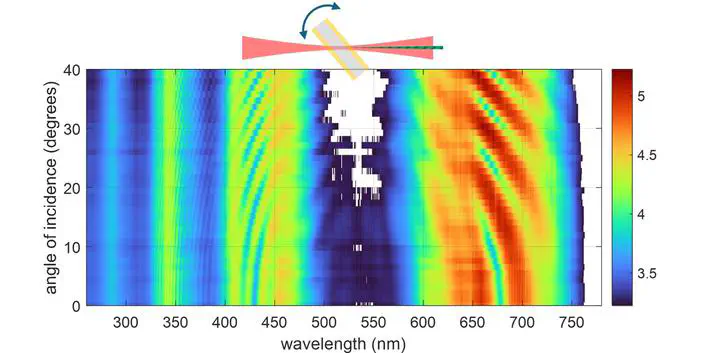
Our approach is remarkably simple: we coat both sides of a sapphire substrate with ZnO thin films that are only about 50 nm thick. A single few-cycle mid-infrared laser pulse generates high harmonics in both films, and the two harmonic beams interfere on the detector. Because both harmonic sources sit on the same solid sample and share a common beam path, the interferometer is monolithic and therefore inherently stable, so no delicate interferometric setup is required.
This stability allows us to precisely track how the phase of the harmonics changes with laser intensity. Experiments at the mid-infrared laser of ELI-ALPS, together with pulse propagation simulations, reveal a strongly intensity-dependent dipole phase. This provides evidence that harmonics just above the bandgap of ZnO are dominantly produced by electron-hole recollisions, which are facilitated by Bloch oscillations. Beyond this result, our compact scheme is a promising platform for studying material-specific responses and for time-resolved interferometry in pump-probe experiments.
The work was carried out in collaboration with colleagues at ELI-ALPS, the University of Debrecen, and the Institute of Applied Physics in Jena. Read the preprint “Measuring the dipole phase of Bloch-trajectory harmonics using a monolithic interferometer” on the arXiv.

Matthias Kübel
Junior Research Group Leader
My research interests include attosecond science, atomic and molecular physics and ultrafast laser technology.